Overview
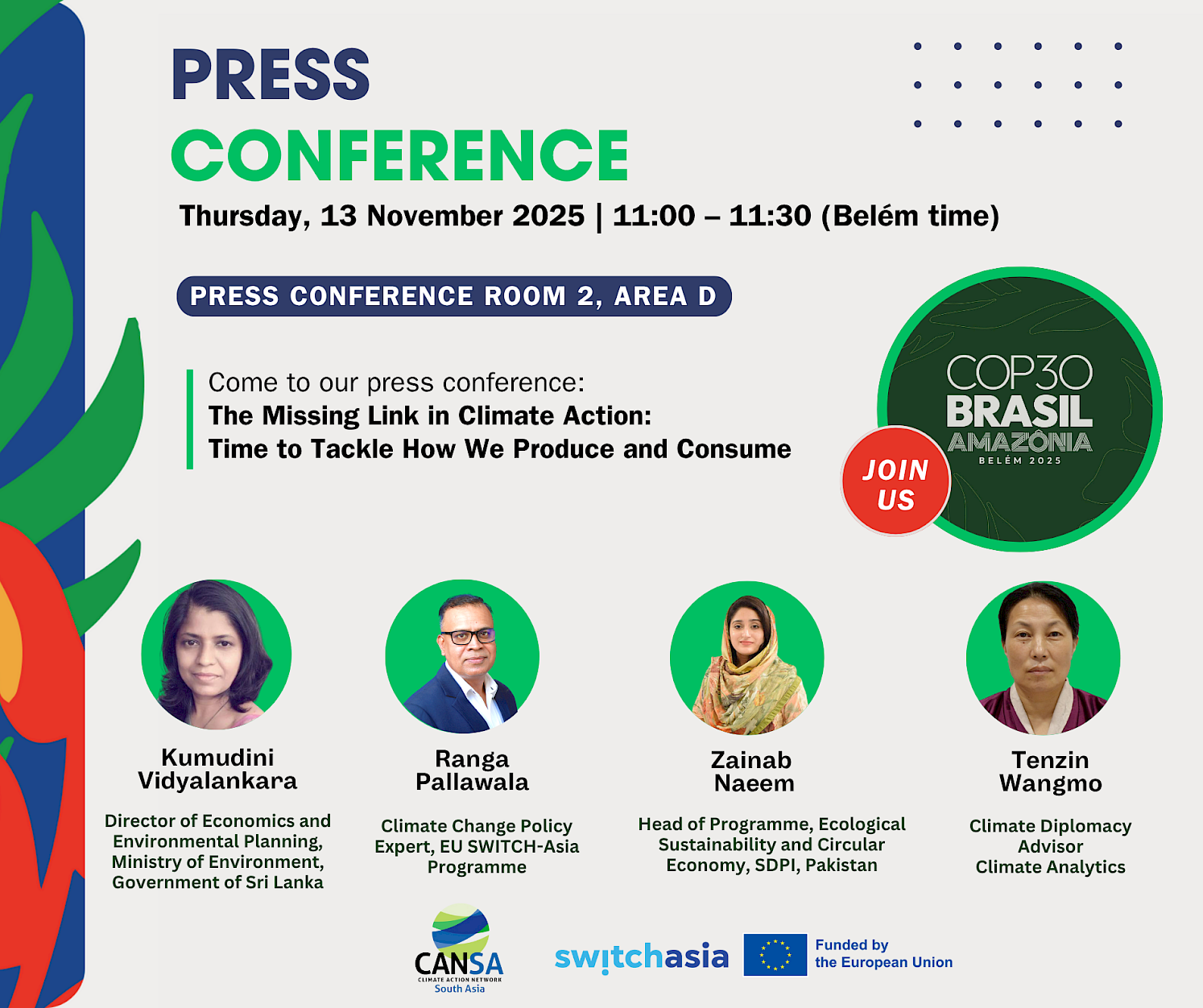
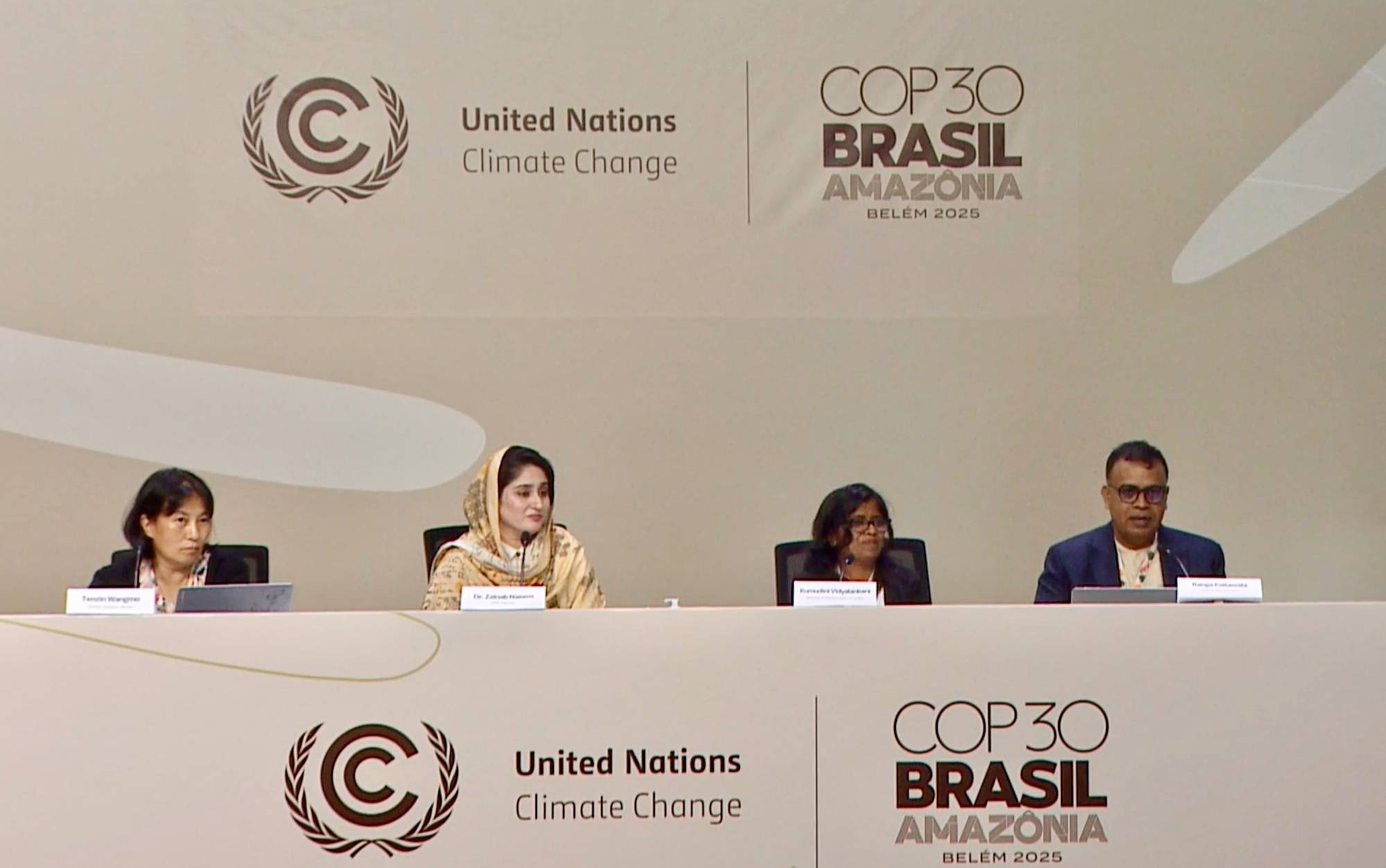
At COP30 in Belém, experts from across South Asia convened to bring one message to the global stage:
The climate crisis cannot be solved without transforming how the world produces, consumes, and manages materials.
While global negotiations continue to centre on fossil fuel phase-out and energy transitions, the discussion underscored that upstream interventions—resource efficiency, design innovation, waste prevention, and circularity—are equally indispensable. This policy brief distils the insights shared during the press conference and highlights why SCP and CE must become core pillars of future climate ambition.
Why SCP and Circular Economy Matter for the Climate Agenda
Scientific assessments from the IPCC and International Resource Panel show that over 60% of global emissions are linked to material extraction, processing, and consumption. As countries struggle to stay on the 1.5°C pathway, circular approaches offer:
- Cost-effective and immediate emission reductions
- Lower material demand for both mitigation and adaptation infrastructure
- Improved resource security and resilience
- Reduced rebound effects created by linear production systems
Circularity is not a “nice-to-have”—it is a structural requirement for achieving climate goals.
Regional Insights and Policy Pathways Highlighted at COP30
1. Rethinking Climate Mitigation and Adaptation Through Materials
Ranga Pallawala, Climate Policy Expert, SWITCH-Asia Programme
- Climate strategies remain overly energy-centric, overlooking the material-emissions nexus.
- Circular interventions, namely, durability, repairability, reduced material throughput—can unlock some of the largest untapped mitigation opportunities.
- Adaptation projects (infrastructure, housing, resilience systems) are extremely material-intensive; without circularity, countries risk generating “adaptation emissions.”
Key implication: Climate ambition must include upstream material-use strategies for both mitigation and adaptation planning.
2. Green Public Procurement (GPP) as a Market-Shaping Climate Tool
Kumudini Vidyalankara, Ministry of Environment, Sri Lanka
- GPP embeds environmental criteria into public sector spending, influencing entire supply chains.
- By mandating lifecycle-based procurement, governments can advance:
- Mitigation commitments through emissions-efficient procurement
- Adaptation commitments via durable, circular infrastructure
- Long-term market transformation toward sustainability
Key implication: GPP is a high-impact, scalable governance tool for aligning national economies with climate-compatible development.
3. Extended Producer Responsibility (EPR) and the Call for Global Consumer Responsibility
Dr. Zainab Naeem, SDPI Pakistan
- EPR must expand beyond plastics to include textiles, construction materials, electronics, and other waste-intensive sectors.
- Developing countries face economic constraints; producers contribute significantly to national revenues.
- High-consumption countries must share responsibility through Extended Consumer Responsibility (ECR)—financial support, technology transfer, and capacity-building.
Key implication: A fair, climate-aligned circular transition requires shared global responsibility, not producer-centric models.
4. Bhutan’s Circular Economy Transition: Lessons for Small and Resource-Rich Economies
Tenzin Wangmo, Climate Analytics
Bhutan’s integration of CE into its NDCs and LT-LEDS shows how circularity supports carbon neutrality and economic resilience. Priority areas include:
- Modernising timber value chains
- Circular construction practices
- Resource-efficient small industries
Key implication: Strong governance, technology access, and support for small producers are crucial to scaling circular practices in emerging economies.
Practical Examples: Circularity in Action
Speakers highlighted real-world interventions demonstrating immediate climate benefits:
- Universal Type-C chargers → reduced redundant production and e-waste
- Low-carbon cement (clinker substitutes) → major emission cuts in construction and adaptation projects
- Design-stage interventions → highest-impact leverage point for lifecycle emission reductions
What This Means for Climate Policymakers and Practitioners
1. Circularity must be embedded into NDCs, LT-LEDS, and national climate strategies.
It is foundational to cost-effective climate mitigation and climate-resilient development.
2. Policymakers should prioritise upstream interventions over downstream waste management.
Design, production efficiency, and reduced material extraction yield the greatest climate gains.
3. Governments should scale tools like GPP, EPR, and material standards to reshape markets.
These create predictable demand for sustainable alternatives, influencing private-sector innovation.
4. Global cooperation is essential to equitable circular transitions.
High-consuming nations must support technology, financing, and knowledge transfer.
5. Countries should address “adaptation emissions.”
Infrastructure and resilience projects must follow material-efficient, circular principles to avoid undermining climate goals.
Watch the full press conference recording:
This event was moderated by Mr. Shailendra Yashwant, Senior Advisor, Communications and Advocacy, Climate Action Network South Asia.
Co-Organisers: Climate Action Network South Asia (CANSA) & SWITCH-Asia Programme