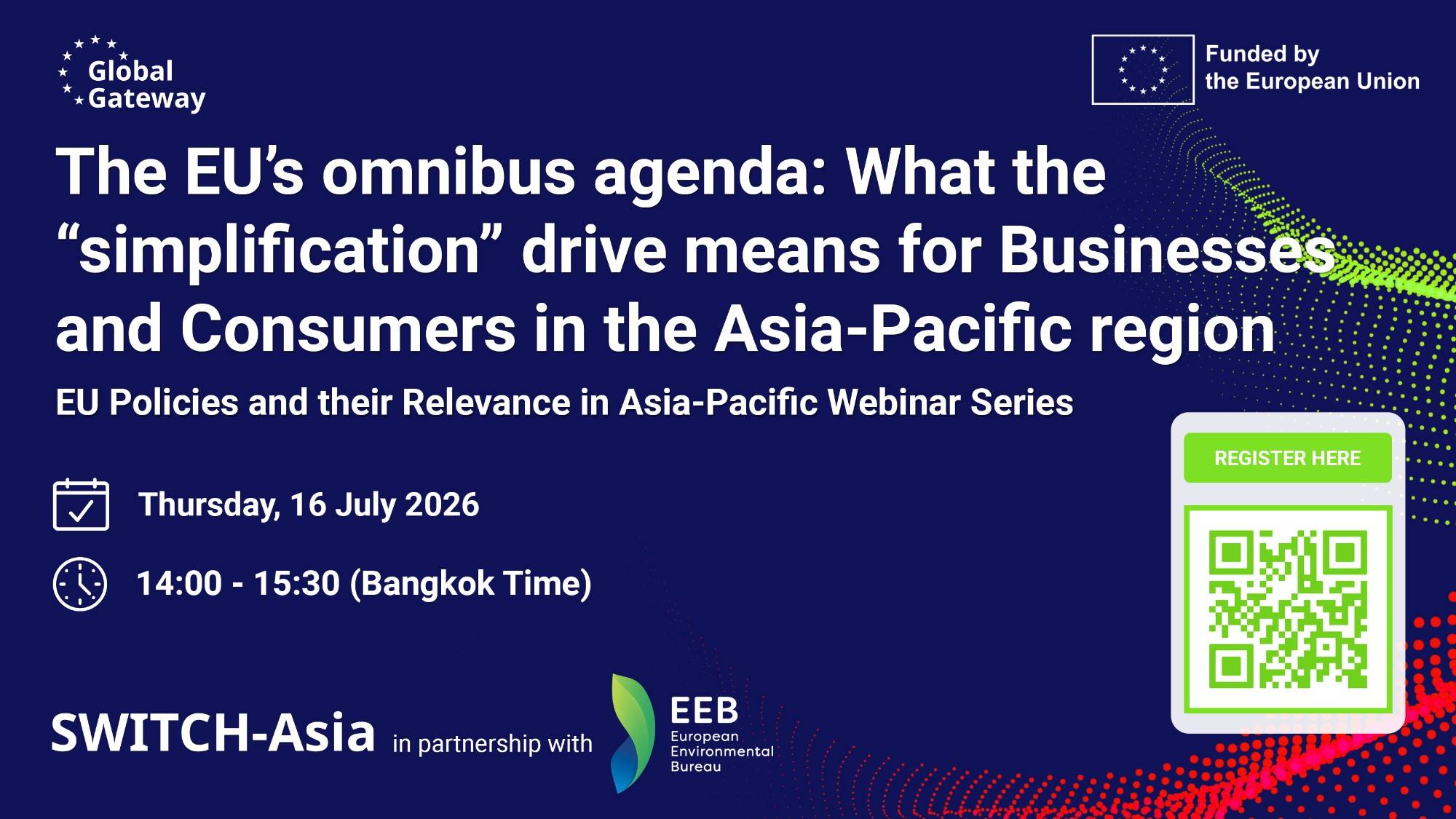
WHEN: 16 July 2026 I TIME: 14:00 - 15:30 (Bangkok Time)
Background
The European Commission operates in election cycles of five years. The Green Deal was adopted during the 2019-2024 mandate, and the agenda of the 2024-2029 Commission has shifted following the elections in June 2024. Commission president Ursula von der Leyen has been consistent in stating that the Green Deal priorities are still alive, but the deal has been complemented by a new agenda that centres competitiveness, and with that, regulatory simplification.
The EU’s simplification and implementation agenda is not new per se, but it has been reignited with renewed vigour during this period. Many stakeholders are concerned that this agenda is leading to deregulation and an erosion of the standards that was set by the Green Deal. This is a concern for citizens as well as businesses, who depend on legislative certainty in order to plan for investments and compliance.
The first “omnibus” package was proposed in February 2025, to simplify and streamline the Corporate Sustainability Reporting Directive (CSRD), which streamlines non-financial reporting requirements, the Corporate Sustainability Due Diligence Directive (CSDDD), which mandates organisational awareness of possible issues in the supply chain, the EU Taxonomy for sustainable investments, and the Carbon Border Adjustment Mechanism (CBAM). The inter-institutional negotiation process ended in February 2026, with a reduced scope of the laws. More than 9 following omnibus proposals have since been announced/presented, covering everything from food & feed, to chemicals, to automotive, to housing, to environmental policy. These are still being negotiated. In addition, the Commission has announced a “stress test” of all environmental and nature laws, and “simplification” as a core part of all new legislative proposals.
Most Asian countries consider the EU an important trading partner and have started investing in compliance with the Green Deal. The many omnibus proposals and the lack of clarity around key pieces of legislation such as the Deforestation Regulation (EUDR) have caused considerable uncertainty among governments and businesses that have or are planning to invest in complying with EU market requirements.
Webinar Session:
The EU SWITCH-Asia Policy Support Component and the European Environmental Bureau, are convening the webinar, The EU’s Omnibus Agenda: What the “simplification” drive could mean for Business and Consumers in the Asia-Pacific region to:
- Discuss the EU’s competitiveness and simplification agenda and what it could mean for Asian businesses and consumers.
- Understand what changes are set in stone and which are still pending.
- Discuss the challenges and opportunities for businesses in navigating the uncertainty around legislative reopening.
Moderator:

Elodie MARIA-SUBE, Expert on EU policy development and partnership building at the SWITCH-Asia Policy Support Component
Elodie is specialized in European Affairs related to topics of circular economy, SCP, climate change and environmental management, and has extensive experience in stakeholder consultation and engagement at the EU level, as well as with high-level officials in Ministries of Environment and Finance in Asia. For over a decade, Elodie has worked in South and South-East Asia on environment and climate change. She is currently leading the SWITCH-Asia Technical Advisory project on Sustainable/ Green Public Procurement for Transformation.
Speakers:
 Zinaida FADEEVA, Team Leader, SWITCH-Asia Policy Support Component
Zinaida Fadeeva is the Team Leader of the Policy Support Component of the SWITCH-Asia Programme. Zinaida has over 25 years leading international professional experience in policy for and practice of sustainable consumption and production (SCP) and Education for Sustainable Development, amongst others working with the United Nations University Institute for the Advanced Studies of Sustainability (UNU-IAS). Her work has focused on diverse topics such as tourism, plastics, construction, small and medium enterprises, procurement and lifestyle. Zinaida has worked extensively with governments, private sector, international organisations and academia in East, South East, South and Central Asia.
 Eva BILLE, Head of Circular Economy, European Environment Bureau
Eva is in charge of the EEB activities around circular economy policy. She studied economics and graduated with a Master’s Degree specialising in resources, development and growth from Tilburg University. She has previously spent 10+ years as an EU policy consultant, working with major companies and trade associations in the Brussels bubble. She has also worked for the UN in Lebanon and spent 4 years working in China.
 Ewa MALZ, Head of Unit, Strategy, Digitilization, Better Regulation and Economic Analysis, DG Environment
Ewa Malz is currently serving as a Head of Unit at the European Commission. She is part of the Directorate-General for Environment (DG ENV), specifically within the unit for Strategy, Digitalization, Better Regulation & Economic Analysis. Based in Brussels, her work focuses on policy strategy and economic analysis within the EU environmental framework.
 Vir MEHTA, Decent Work and PMEL, Solidaridad
Vir Mehta leads the Decent Work and PMEL portfolio at Solidaridad India, where he works to strengthen labour rights and responsible business conduct across agricultural and textile value chains. He supports companies and producer organisations in operationalising human rights and environmental due diligence, including through Solidaridad’s CSDDD Readiness Toolkit, which helps suppliers in the Global South interpret and respond to emerging EU requirements. Vir has contributed to multi-stakeholder initiatives on inclusive supply chain governance and has overseen field-based evidence generation on working conditions and climate-resilient livelihoods in India.
 Martin BRISSON, Executive Director, EuroCham Cambodia
After almost 4 years as Executive director of the French Chamber of Commerce and Industry in Cambodia (CCIFC), Martin Brisson joined EuroCham Cambodia as Deputy Executive Director in December 2022. From 2015 to 2017, Martin worked as an economic and commercial attaché (VIA) at the French Embassy in Cambodia, in connection with Business France Vietnam. As the only representative of Business France in Cambodia, he successfully accompanied more than thirty companies on the Cambodian market with prospecting and market research missions.
 Matt FEEHILY, Simpson Thacher & Bartlett LLP
Matt Feehily is a Partner in the Firm’s Sustainability and Environmental, Social and Governance (ESG) Practice. He represents a broad range of clients, including private equity firms, project sponsors, portfolio companies and corporations, and covers novel and complex legal issues in an emerging area of law and regulation. Matt has extensive experience advising on EU and UK regulatory frameworks for sustainable finance and ESG disclosures at product, firm and company levels, including under the EU Sustainable Finance Disclosure Regulation (SFDR), EU Taxonomy Regulation, the EU Corporate Sustainability Reporting Directive (CSRD), and UK Task Force on Climate-related Financial Disclosure (TCFD) reporting regimes.
Agenda:
|
16 July 2026 |
|
|
14:00 |
Introduction to the Webinar
|
|
14:05 |
Presentation: EU’s simplification agenda from the perspective of civil society
|
|
14:20 |
Panel Discussion: EU’s omnibus agenda – what the simplification drive means for businesses and consumers in the Asia-Pacific region Moderated by Elodie MARIA-SUBE, Key Expert on EU policy development and partnership building, SWITCH-Asia Policy Support Component
|
|
15:00 |
Q&A |
|
15:25 |
Concluding Remarks and Next Steps
|