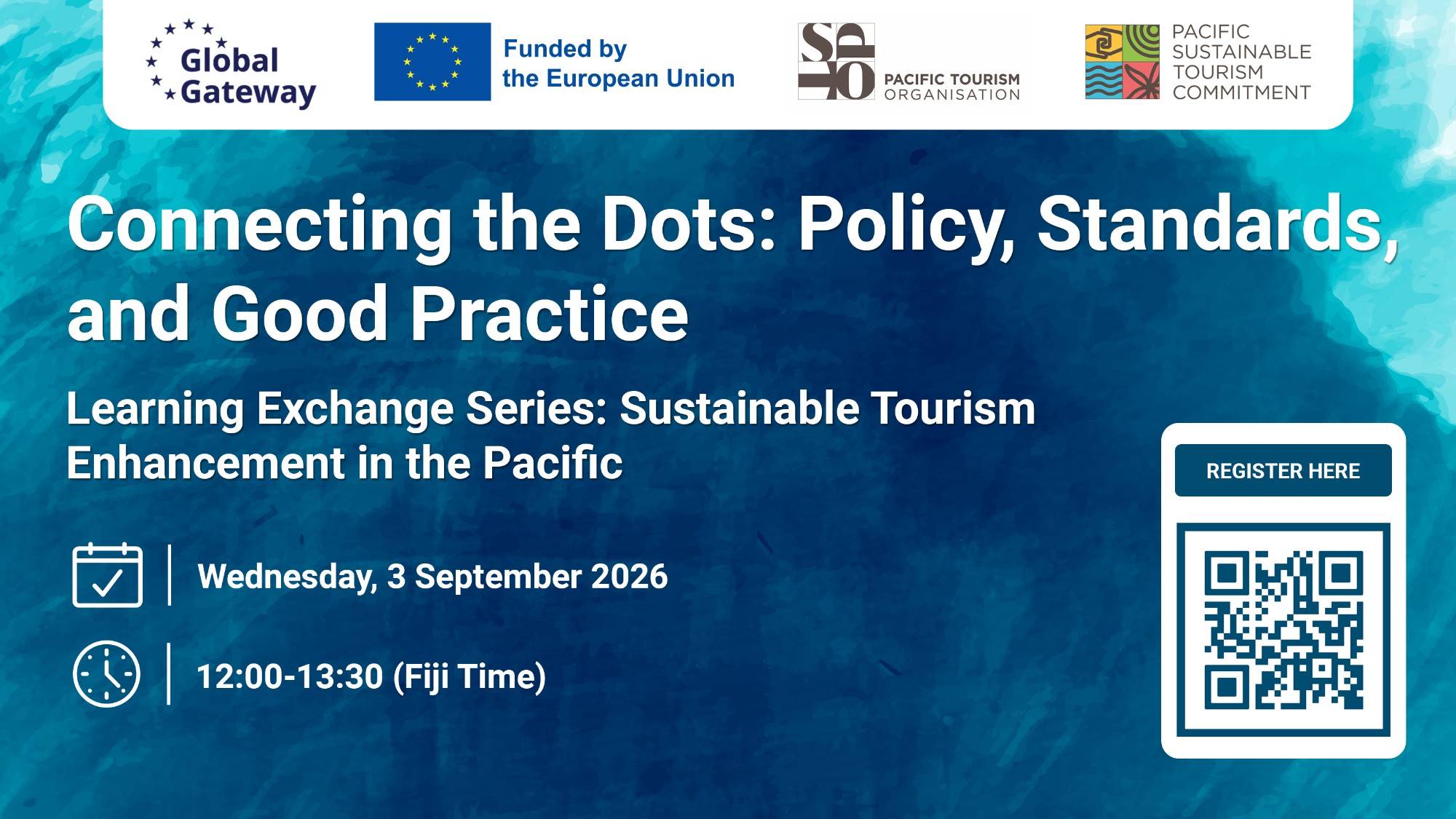
WHEN: 3 September 2026 I TIME: 12:00 - 13:30 (Fiji Time)
Background:
Across the Pacific, tourism is entering a pivotal phase in its transition towards a more sustainable, resilient and competitive future. As destinations seek to balance economic growth with environmental stewardship, cultural integrity and community wellbeing, sustainable consumption and production (SCP) and circular economy approaches are becoming increasingly important for ensuring tourism creates long-term value while reducing pressure on natural resources. The challenge is no longer whether tourism should become more sustainable, but how governments, destinations and tourism businesses can translate sustainability commitments into everyday practice. This means finding practical ways to improve resource efficiency, reduce food waste, phase out single-use plastics, conserve water and energy, strengthen local procurement and value chains, extend the life of tourism assets and products, and support more responsible destination management.
Across the region, many destinations are asking similar questions:
- How do we translate sustainable consumption and production principles into practical action?
- Where should we begin?
- What governance arrangements best support sustainable tourism transformation?
- How can tourism businesses progressively adopt more resource-efficient and circular practices?
- What implementation pathway best reflects national circumstances while delivering lasting change?
The Sustainable Tourism Enhancement in the Pacific (STEP) Project, funded by the European Union under the SWITCH-Asia Programme and co-implemented by the Pacific Tourism Organisation (SPTO), was launched in August 2024. Phase II, which commenced in October 2025, provides tailored support to four demonstration countries Fiji, Kiribati, Samoa and Vanuatu - to strengthen national approaches to sustainable tourism by adapting and implementing the Pacific Sustainable Tourism Standards in ways that reflect their tourism industries, governance arrangements and national development priorities.
Rather than viewing the Pacific Sustainable Tourism Standards as an end in themselves, STEP positions them as a practical implementation framework for advancing sustainable consumption and production and circular economy objectives across the tourism sector. The standards provide governments and businesses with a practical mechanism for embedding sustainability into tourism policy, planning, destination management and business operations. In doing so, they support more efficient use of energy, water and materials, encourage waste reduction and circular resource use, strengthen local supply chains and create more resilient tourism economies that generate lasting benefits for communities and destinations. In this way, the standards provide a practical bridge between policy commitments and measurable action. They help translate sustainability ambitions into improved governance, stronger industry performance and continuous destination improvement, enabling countries to progressively transition towards more sustainable, resource-efficient and circular tourism systems.
Experience across the four demonstration countries confirms that there is no single pathway to implementation. While national approaches differ according to institutional arrangements, tourism maturity and available resources, the standards provide a common framework through which countries can progressively strengthen governance, build institutional capability, support industry improvement and accelerate sustainable consumption and production outcomes.
Four interconnected implementation themes have emerged across the STEP Project. Together, they represent practical pathways for enabling tourism systems to transition towards more sustainable, resilient and circular models of development.
- Policy and Governance: Establishing governance, legal and institutional arrangements that enable destinations to progressively transition towards more sustainable, resource-efficient and circular tourism systems.
- Capacity and Learning Ecosystems: Building the knowledge, skills, partnerships and institutional capability needed to support governments, tourism businesses and stakeholders in implementing sustainable consumption and production and circular economy approaches.
- Industry Improvement Pathways: Supporting tourism businesses to progressively adopt more resource-efficient and circular business practices through practical guidance, mentoring, technology, innovation and industry leadership.
- Resourcing Models: Exploring sustainable financing and investment approaches that enable the long-term transition towards resilient, competitive and circular tourism economies.
To share these lessons, the EU SWITCH-Asia Policy Support Component and SPTO are delivering a four-part regional webinar series exploring different national experiences, implementation pathways and practical approaches to embedding sustainable consumption and production into tourism development.
Webinar Series Objectives
The webinar series aims to:
- Demonstrate how tourism standards can serve as practical implementation tools for accelerating sustainable consumption and production and circular economy outcomes across Pacific destinations.
- Share experiences from the four STEP demonstration countries in adapting and implementing the Pacific Sustainable Tourism Standards to reflect national priorities and tourism contexts.
- Explore how governance, policy, capacity development, financing and industry partnerships enable sustainable tourism transformation.
- Showcase practical tools, resources and lessons that support governments and tourism stakeholders in strengthening resource efficiency, reducing waste, improving local value chains and embedding continuous sustainability improvement across the tourism sector.
The webinar series is designed as a regional learning exchange, bringing together governments, National Tourism Organisations, industry representatives and development partners to share experiences, discuss common implementation challenges and identify practical solutions that can be adapted across Pacific destinations. By strengthening regional collaboration and peer learning, the series aims to accelerate the uptake of practical approaches that help destinations embed sustainable consumption and production and circular economy principles into tourism policy, governance and business practice. In doing so, it seeks to strengthen the resilience, competitiveness and long-term sustainability of Pacific tourism systems.
Building on the first webinar, which explored Samoa and Kiribati’s experiences, this second webinar examines the distinct yet complementary approaches of Fiji and Vanuatu to strengthening tourism policy, governance and standards frameworks. The discussion highlights how effective policy and standards not only improve sustainability performance, but also create the enabling conditions, incentives and accountability mechanisms that drive practical changes across the tourism value chain, shaping how businesses use materials, water, energy and food, manage waste and strengthen local sourcing and supply-chain linkages. Importantly, it explores how sustainability and circular economy practices can move beyond isolated actions by individual businesses to become systematically embedded across an entire industry and destination through well-designed policy, governance and standards frameworks.
Webinar 2:
The EU SWITCH-Asia Policy Support Component and the SPTO are convening this second webinar on: Connecting the Dots: Policy, Standards and Good Practice. It will highlight the critical interdependencies between policy, governance, standards and industry practice. It explores how strong policy and governance frameworks create the enabling conditions for effective tourism standards programmes. These frameworks play a vital role in supporting industry transformation by setting clear directions, strengthening oversight and encouraging the adoption of sustainable and circular business practices that enhance destination resilience and long-term competitiveness.
The session will:
- Examine how tourism standards programmes, supported by strong policy, governance and legislative frameworks, can drive industry improvement and incentivise investment by businesses, governments and development partners.
- Explore Fiji's journey in building a robust policy and governance ecosystem as the foundation for the development of a fit-for-purpose tourism standards programme for a diverse tourism destination.
- Highlight Vanuatu's experience in reviewing and strengthening its tourism accreditation framework and operator standards, alongside broader sustainable tourism strategy and legislative reforms.
- Facilitate peer learning on practical approaches for aligning policy, governance and standards to support sustainable consumption and production, accelerate circular tourism practices and deliver measurable industry and destination outcomes.
Moderator
 Christina Leala-Gale, Sustainable Tourism Manager, SPTO
Speakers

Erik Lindebo, Team Leader, Climate Adaptation, Water and Environment, EU Delegation to the Pacific

Dr Zinaida Fadeeva, Team Leader, SWITCH-Asia Policy Support Component
 Lusia Matairakula, Sustainable Tourism Officer, SPTO
 Geraldine Tari Natu, Principal Accreditation Officer, Vanuatu Department of Tourism
Catherine Lesinaivalu, Tourism Officer, Fiji Ministry of Tourism and Civil Aviation (MTCA)
Agenda
|
3 September 2026 |
|
|
12:00 |
Introduction to the Webinar and Opening Remakrs
|
|
12:10 |
Overview
|
|
12:15 |
Learning Exchange Panel: Experiences of Fiji and Vanuatu Moderated by Christina Leala-Gale, Sustainable Tourism Manager, SPTO
|
|
13:00 |
Q&A |
|
13:15 |
Concluding Remarks and Next Steps
|