WHEN: 15 July 2026 I TIME: 14:00 - 15:45 (Manila Time)
Background:
Southeast Asia has committed to transition to Circular Economy to support more resilient economies, sustainable growth, and resource efficiency, through the 2021 ASEAN Circular Economy Framework. This is complemented by national policy and action plans in ASEAN Member States, including the Philippines. The Philippine government has adopted a Philippine Action Plan for Sustainable Consumption and Production, enacted an Extended Producer Responsibility Act, and is implementing sustainable public procurement and other related initiatives to facilitate transition to a low carbon, resource efficient, and circular economy. Leading businesses and organisations in the Philippines and in the ASEAN region have started to benefit from the adoption of Circular Economy practices in sectors as diverse as hospitality, building materials, agri-food, textiles, and recycling and resource recovery.
The ASEAN Circular Economy Business Alliance (ACEBA) was launched in 2024 to further facilitate business leadership and action on Circular Economy, in support of Philippine and regional policies, plans, and strategies. ACEBA engages businesses through advocacy, knowledge and experience sharing, capacity building, and networking. Key partners are the: Cebu Chamber of Commerce and Industry (CCCI), one of the oldest chambers of commerce in the country, acts as the ACEBA country lead for the Philippines; and Global Compact Network Philippines, the national network of the United Nations Global Compact that brings together Philippine companies and non-business stakeholders who have committed to uphold and operationalize the Ten Principles of the UNGC (foundational business responsibilities in the areas of human rights, labour, environment, and anti-corruption). This year, ACEBA, CCCI, and GCNP are co-hosting the Circular Business Webinar Series to deepen understanding of the circular economy, and facilitate circular business learning— on design, development, implementation, and assessment—among Philippine businesses, including start-ups and Micro, Small, and Medium Enterprises (MSMEs). Each webinar/ session in this series is envisioned to generate business interest, ideas, and action plans for circular business innovation, design, and implementation.
Making Circular Economy Work for Your Business
Circular Economy is, principally, relevant to any business—regardless of size, age, sector, location, market, and ownership structure. The operationalization of Circular Economy, however, requires tailored approaches considering a business’ specific operating environment; its products, services, and business processes; the value chains it is part of; and its maturity in understanding and committing to Circular Economy. The starting point in engaging with the Circular Economy is initial business interest or intention to commit to circularity. This is likely to arise from exposure to Circular Economy and “circular business” through interactions with early adopters or champions of circular business, government and regulatory agencies, consumers, advocacy groups/ networks, or other stakeholders. The adoption of circular business approaches and practices will be different for every business and organization but a key question among many businesses/ entrepreneurs is “How can I start to “circularize” my business?”
ACEBA Philippines Circular Business Webinar Series: Circular Business Transition
This third session of this webinar series will focus on key activities that any business may undertake to advance circular business transition. This webinar will introduce ACEBA’s “SADI Framework”, which organizes these key activities into four practical functional clusters: Stocktake, Ambition-setting, Delivery, and Integration (SADI).
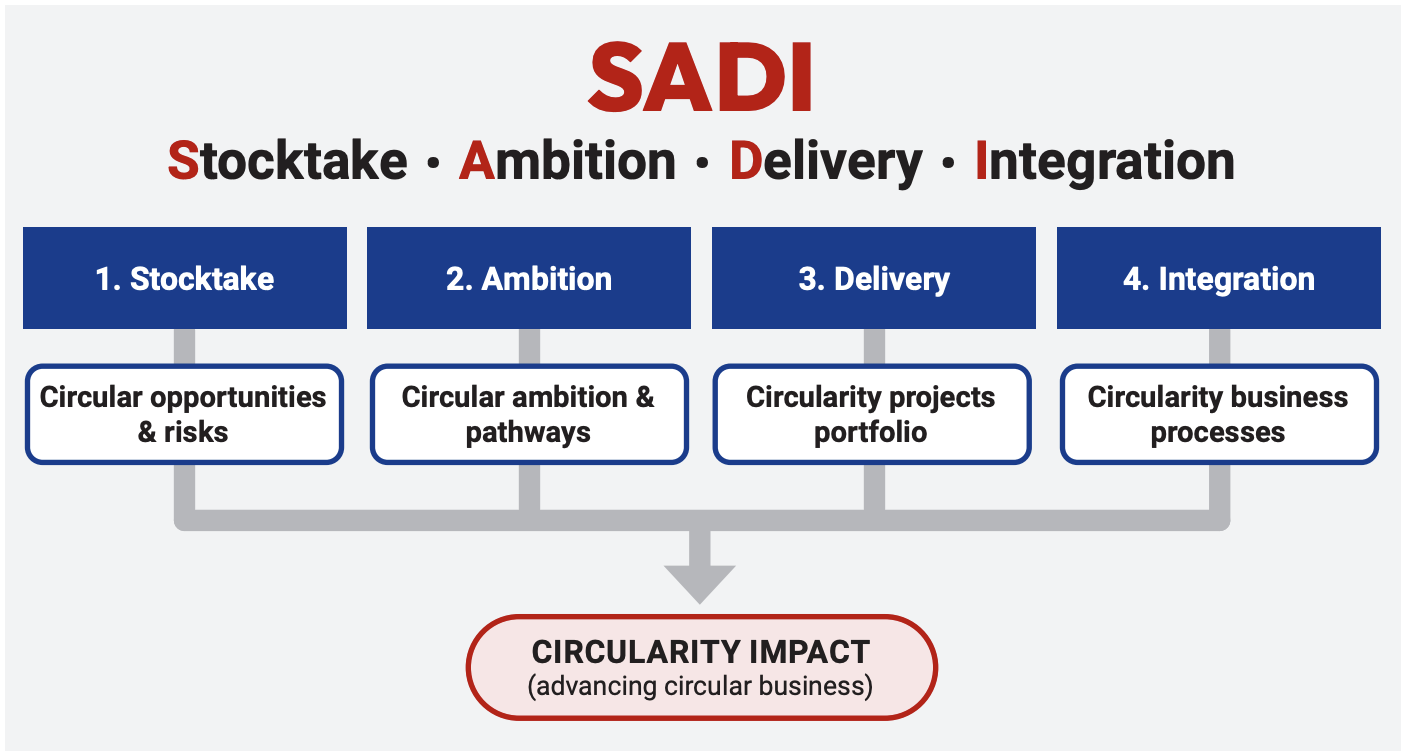
This webinar will also be informed by selected circular business practices and models in ASEAN, particularly in the Philippines, as shown in the business cases curated by ACEBA and the EU SWITCH-Asia Policy Support Component since 2023.
Target Participants. This webinar is designed to engage business and industry professionals involved in business management, operations, product and business development, environment and sustainability, research and innovation, and related areas. The session is not sector-specific, and will cover Circular Economy and circular business perspectives and ideas applicable to a wide range of sectors and industries.
Resource/ reference material. The primary resource material for this webinar is the activity menu for business outlined in “Unlocking the Circularity Opportunity: Guidance to Advance Circular Business”. Participants may download and read this reference material in advance.
Agenda
|
Time |
Activity |
|
2:00 – 2:05 PM |
Opening and webinar overview |
|
2:05 – 2:15 |
Welcome remarks
|
|
2:15 – 2:30 |
Stocktaking and Ambition-setting: Clarifying justification for Circular Economy/ Circular Business transition, and identifying the transformative impacts envisioned for the company. Dr. Rene Van Berkel, Co-convenor, ACEBA; Senior Expert, EU SWITCH-Asia Policy Support Component |
|
2:30 – 2:40 |
Q&A with participants |
|
2:40 – 2:50 |
Delivery and Integration: Planning practical execution of circular business initiatives or projects, and adapting business management, processes, and operations to circular business ambitions. Dr. Rene Van Berkel, Co-convenor, ACEBA; Senior Expert, EU SWITCH-Asia Policy Support Component |
|
2:50 – 3:20 |
Panel: Experience sharing with business Moderator: Mr. Thomas Thomas, Co-convenor, ACEBA; Chair, ARAIBA Sdn Bhd
|
|
3:20 – 3:35 |
Getting Started with the Circular Business Check: Introduction and overview of self-diagnostic tool for circular economy preparedness, maturity, and impact of small and medium enterprises (SMEs) Dr. Rene Van Berkel, Co-convenor, ACEBA; Senior Expert, EU SWITCH-Asia Policy Support Component |
|
3:35 – 3:45 |
Q&A with participants |
|
3:45 |
Closing |