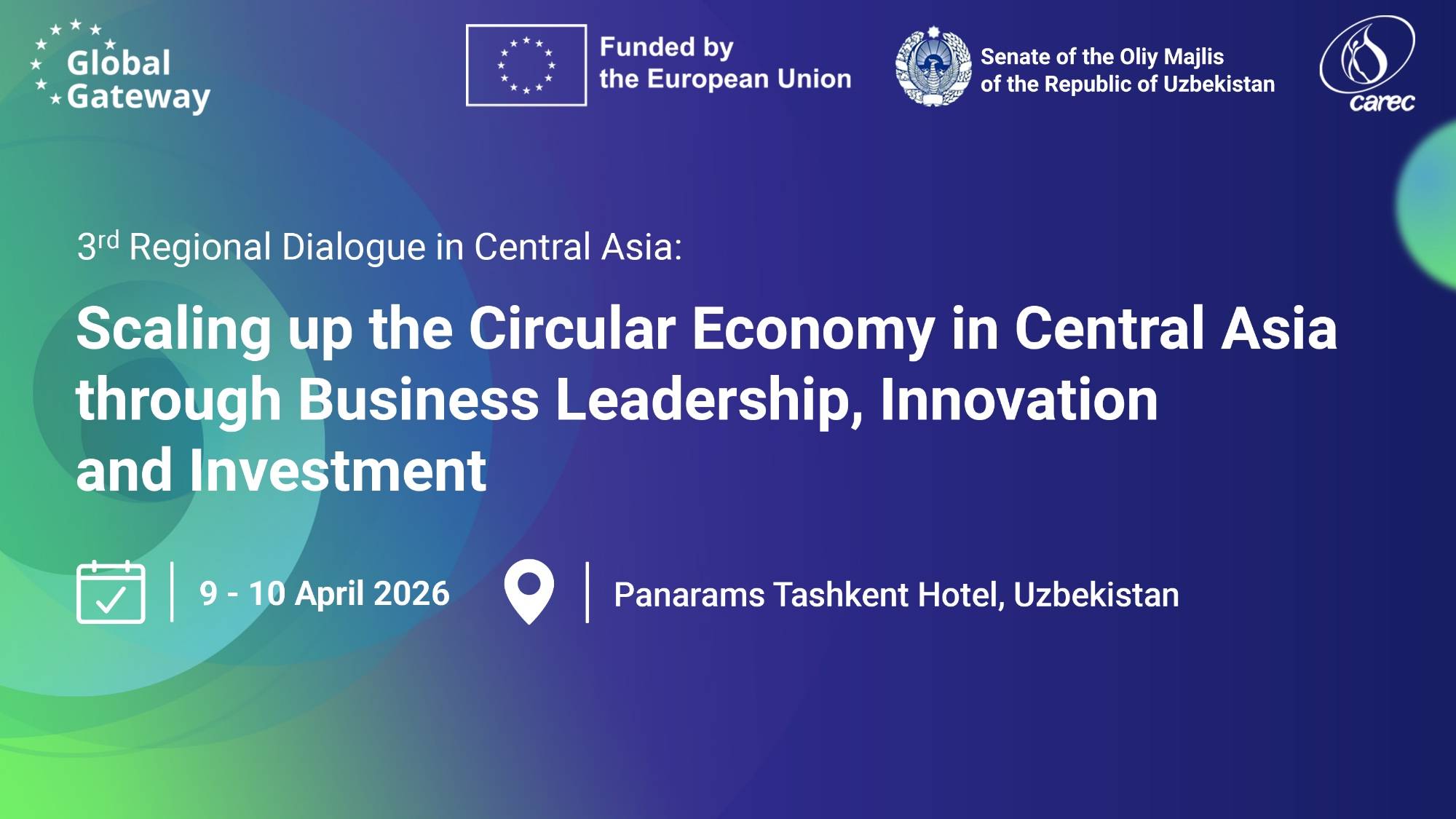
WHEN: 9-10 April 2026 I TIME: 9:00 - 19:00 (Tashkent Time) I VENUE: Panarams Tashkent Hotel, Tashkent, Uzbekistan I by invitation only event
Background:
In recent years, there has been a growing interest in circular economy among governments in Central Asia. There is increasing acknowledgement of the vision of circular economy where the value of products, materials and resources is maintained in the economy for as long as possible, notably by focusing on waste reduction, resource efficiency, and designing systems that keep products and materials in use.
The circular economy is a key pillar of the European Green Deal, EU’s strategy to achieve climate neutrality by 2050, and the Global Gateway, EU’s positive offer to accelerate sustainable investments in partner countries in support of the Sustainable Development Goals. Sustainable consumption and production, along with the transition to a circular economy, are integral to Global Gateway’s focus on sustainable infrastructure for climate action, green transition and support to sustainable value chains. By fostering policy dialogue, knowledge exchange, and legislative engagement, SWITCH-Asia connects Central Asia with the Global Gateway and supports its transition toward circular value chains - enhancing regional sustainability, economic resilience, and alignment with international and EU policies.
The Regional Dialogue on Circular Economy of the Central Asia Parliamentarian Platform was designed to create conditions for further strengthening cooperation on the implementation of circular economy principles in the region and thereby nationally. Two successful regional dialogues have been convened so far. Both dialogues achieved significant results by bringing together parliamentarians from Kazakhstan, Kyrgyzstan, Tajikistan, Turkmenistan and Uzbekistan, as well as representatives of governments, the European Union, CAREC, the business community, expert organisations and specialists from the SWITCH-Asia Programme.
The first dialogue, held in Bishkek in May 2025, contributed to developing a shared understanding of circular economy (CE) and sustainable consumption and production (SCP) concepts. The second event, held in October 2025 in Almaty, focused on “Strengthening Policy Ambitions in Sustainable Consumption and Production and Circular Economy.” The Parliamentarians also made valuable contributions to the development of the Central Asia Circular Economy Partnership Framework during the second dialogue.
Building on this momentum, the Third Regional Dialogue will focus on practical application of circular economy principles through business engagement, investment and innovation. This dialogue will further explore how government push complemented with private sector and academic collaboration on innovation can help steer countries to high-value sectors and quality of life. It will also address critical issues of finance for circular economy undertaken both by public and private sectors. In addition to in-room discussion and speeches, the event will include a field visit in Tashkent that demonstrates practices of circular economy principles, offering participants a practical example of circularity in action. The Third Regional Dialogue will make a significant contribution to preparations for the 2026 Regional Environmental Summit in Kazakhstan. Discussions in Tashkent will form the basis for further development of the Central Asia Circular Economy Partnership Framework, the official presentation of which is planned for the 2026 summit. This creates a direct link between ongoing parliamentary engagement and long-term regional environmental governance.
Invited participants:
EU INTPA HQ, EU Delegations in Central Asia, SWITCH-Asia Policy Support Component (PSC), Members of the Parliament (MPs), SWITCH-Asia National Focal Points (NFPs) in Central Asia, other representatives of governments in the Central Asian region, Partners and stakeholders of the SWITCH-Asia Technical Advisories, relevant international organisations and projects, representatives of CAREC.
Objectives:
- Promote and Enhance Regional Cooperation: Facilitate knowledge exchange and discussions on regional challenges and opportunities for adopting circular economy practices in Central Asia.
- Strengthen Parliamentary Engagement: Equip parliamentarians with the tools and knowledge needed to advocate for and legislate CE policies in their respective countries.
- Develop Actionable Policy Recommendations: Provide a platform to discuss policy recommendations, legislative reforms, and national action plans for integrating CE into key sectors.
- Facilitate Cross-issue Discussions: Venture into finance and innovation cross-linkages with circular economy, and identify how each could be exploited to expand the size of the circular economy.
- Facilitate Engagement between Policy Makers and Businesses: Engage businesses and communities in showcasing circular solutions to MPs, strengthening mutual understanding and fostering collaboration for effective CE policies and investments.
Agenda
|
Time |
Session |
Speakers |
|
8:30 AM |
Registration |
|
|
9:00 – 9:45 |
Welcome and Opening Remarks
Keynote Address: Parliamentary Leadership for a Circular Future
|
Emcee: Mr. Shakhboz AKHMEDOV, Senior Expert, SWITCH-Asia PSC
|
|
9:45 – 11:00 |
Session 1: National Progress on Circular Economy in Central Asia
Introduction to the Session
Facilitated Panel of Parliamentarians (10 mins each)
|
Moderator: Dr. Zinaida FADEEVA, Team leader, SWITCH-Asia PSC
|
|
11:00 – 11:30 |
Break and Group Photo |
|
|
11:30 – 12:45 |
Session 2: Business and Project Showcases
Spotlight Cases Interactive Q&A with Parliamentarians
|
Moderator, Dr. Rene Van BERKEL, Senior Circular Economy Expert (EU SWITCH-Asia PSC) and Faculty (Thammasat University, Thailand)
Panelists:
Interventions:
|
|
12:45-13:00 |
Field Visit: Briefing Briefing for the Members of Parliament on the site visit and sessions during the event |
Mr. Shakhboz AKHMEDOV, Senior Expert, SWITCH-Asia PSC |
|
13:00 – 14:00 |
Lunch |
|
|
14:00 – 17:30 |
Field Visit: Circular Economy in Action Guided visit to a leading CE enterprise/practice in Tashkent. On-site presentations and exchanges with management, staff, and stakeholders. |
All participants |
|
19:00 |
Welcome Reception and Networking Dinner
|
All participants Venue: Monica Restaurant, Panarams Tashkent Hotel |
|
10 April 2026 |
||
|
Time |
Session |
Speakers |
|
09:00 – 09:30 |
Debriefing Session on the site visit |
|
|
09:30 – 10:00 |
Opening Framing: Circular Economy and Investment in Central Asia (30 min)
|
Dr. Zinaida FADEEVA, Team leader, SWITCH-Asia PSC
|
|
10:00 – 11:00 |
Session 3: Legislative & Regulatory Levers to Unlock CE Finance
|
Moderator: Mr. Sachin JOSHI, SCP Policy Options and SDG 12 Progress Expert, SWITCH-Asia PSC
Discussion with MPs |
|
11:00 – 11:30 |
Break |
|
|
11:30 - 12:30
|
Session 4: DFIs, MDBs & Financial Tools for Circular Economy Projects and Innovations Objective: Showcase investment instruments, risk mitigation tools, and concrete opportunities from the finance sector that parliamentarians should consider enabling.
|
Moderator: Mr. Sachin JOSHI, SCP Policy Options and SDG 12 Progress Expert, SWITCH-Asia PSC
|
|
12:30 – 13:30 |
Lunch |
|
|
13:30 - 15:00 |
Session 5: Parliamentary Action Lab (40–50 mins) |
Moderated by Mr. Kanat Sultanaliev, Expert, SWITCH-Asia PSC assisted by national experts All participants |
|
15:00 – 16:30 |
Closed-door Meeting of Parliamentarians (By Invitation) Tea / Coffee included in this session |
|
|
16:30 – 17:00 |
Session 6: Closing Session - Key takeaways - Vote of thanks Departures |
All participants |
КРАТКИЙ ОБЗОР ПРОГРАММЫ (программа может быть изменена)
|
9 апреля 2026 |
||
|
Время |
Сессия |
Спикеры |
|
8:30 |
Регистрация |
|
|
9:00 – 9:45 |
Приветствие и вступительное слово
Основное выступление: Парламентское лидерство для циркулярного будущего
|
Ведущий: г-н Шахбоз Ахмедов, старший эксперт, SWITCH-Asia PSC.
|
|
9:45 – 11:00 |
Сессия 1: Национальный прогресс в области циркулярной экономики в Центральной Азии
Введение в сессию
Панель парламентариев при поддержке фасилитатора (по 10 минут на каждого)
|
Модератор: Д-р Зинаида ФАДЕЕВА, руководитель команды, SWITCH-Asia PSC
|
|
11:00 – 11:30 |
Перерыв и групповое фото |
|
|
11:30 – 12:45 |
Сессия 2: Примеры из бизнеса и проектов
Значимые практики (по 5-7 минут каждый)
Интерактивные вопросы и ответы с парламентариями |
Модератор: д-р Рене Ван БЕРКЕЛЬ, старший эксперт по циркулярной экономике, SWITCH Asia PSC и преподаватель (Университет Таммасат, Таиланд) Участники панели:
Участники:
|
|
12:45-13:00 |
Полевой выезд: брифинг Брифинг для членов парламента о полевом выезде и сессиях во время мероприятия |
Г-н Шахбоз АХМЕДОВ, старший эксперт, SWITCH-Asia PSC |
|
13:00 – 14:00 |
Обед |
|
|
14:00 – 17:30 |
Полевой выезд: Циркулярная экономика в действии Посещение с гидом ведущего предприятия/практики по циркулярной экономике в Ташкенте. Презентации на месте и обмен мнениями с руководством, персоналом и заинтересованными сторонами.
|
Все участники |
|
19:00 |
Приветственный прием и совместный ужин |
Все участники Место проведения: ресторан «Моника», |
|
10 апреля 2026 |
||
|
Время |
Сессия |
Спикеры |
|
09:00 – 09:30 |
Подведение итогов полевого выезда |
|
|
09:30 – 10:00 |
Вводная часть: Циркулярная экономика и инвестиции в Центральной Азии
|
Д-р Зинаида ФАДЕЕВА, руководитель команды, SWITCH-Asia PSC Г-н Руслан ТУКЕНОВ, директор Департамента управления отходами Министерства экологии и природных ресурсов Республики Казахстан (уточняется) |
|
10:00 – 11:00 |
Сессия 3: Законодательные и регулятивные рычаги для разблокирования финансирования ЦЭ
|
Модератор: г-н Сачин ДЖОШИ, эксперт по политике УПП и прогрессу в достижении ЦУР 12, SWITCH-Asia PSC Г-жа Пегги Лефорт, руководитель отдела по вопросам загрязнения окружающей среды и циркулярной экономики, Финансовой инициативы Программы ООН по окружающей среде (UNEP FI) (онлайн) г-н Шохзод ИСЛАМОВ, Директор департамента развития зеленой экономики, Министерства экономики и финансов Узбекистана Дискуссия с депутатами парламента |
|
11:00 – 11:30 |
Перерыв |
|
|
11:30 - 12:30
|
Сессия 4: Финансовые фонды, МБР и финансовые инструменты для проектов и инноваций в сфере циркулярной экономики
|
Модератор: г-н Сачин ДЖОШИ, эксперт по политике УПП и прогрессу в достижении ЦУР 12, SWITCH-Asia PSC
|
|
12:30 – 13:30 |
Обед |
|
|
13:30 - 15:00 |
Сессия 5: Лаборатория парламентских действий (40–50 минут)
|
Модерировать будет г-н Канат СУЛТАНАЛИЕВ, эксперт SWITCH-Asia PSC, при участии национальных экспертов. Все участники |
|
15:00 – 16:30 |
Закрытое заседание парламентариев (по приглашению)
|
|
|
16:30 – 17:00 |
Сессия 6: Заключительная сессия - Ключевые выводы - Слова благодарности |
Все участники |